
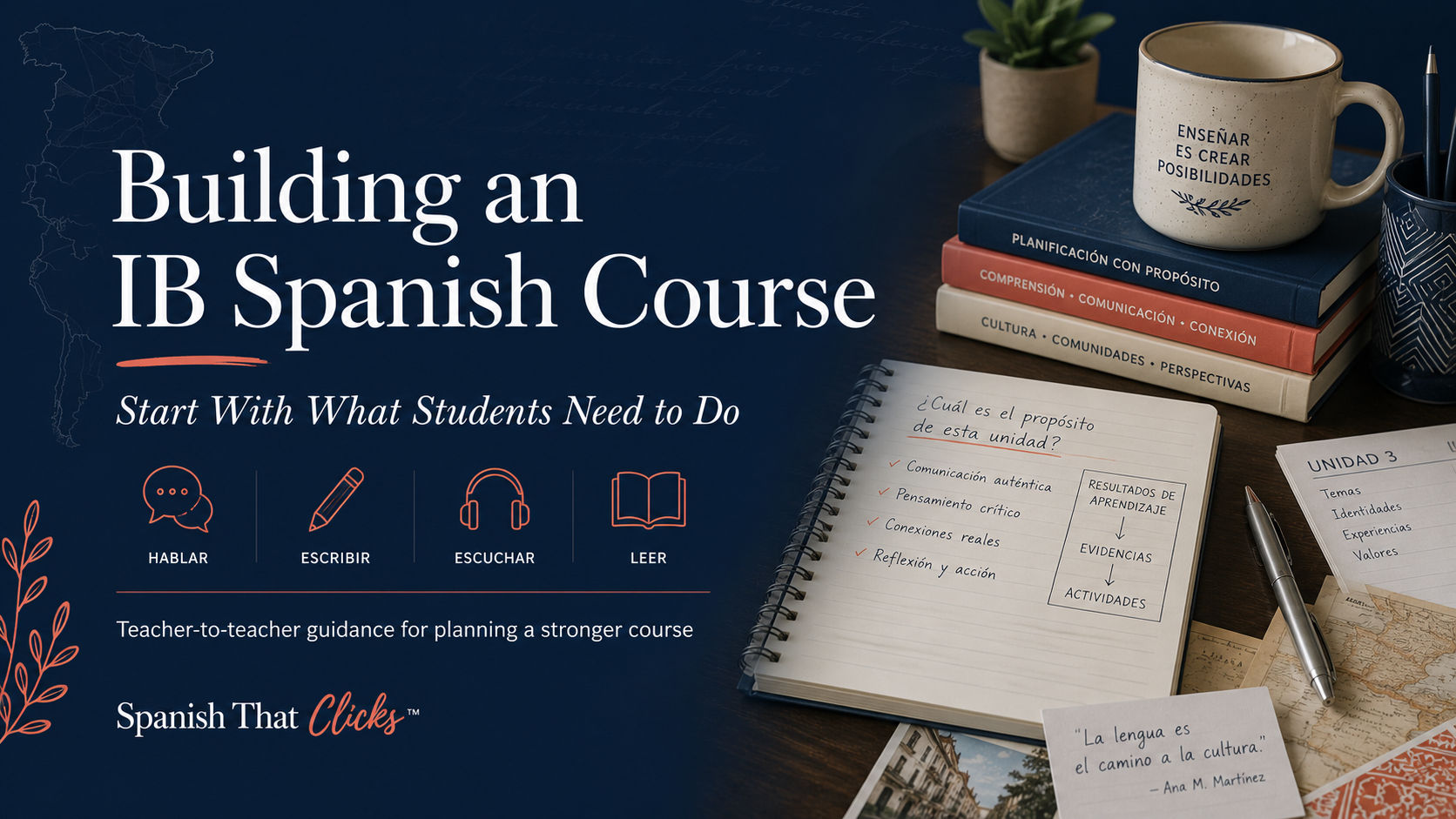
Building an IB Spanish Course: Start With What Students Need to Do
- Jay Rowsey

- Jun 29
- 6 min read
When teachers begin building or revising an IB Spanish course, it is natural to want the binder.
You know the binder I mean.
The perfect one.
The one with every unit mapped out, every theme color-coded, every authentic resource placed in just the right week, every writing task aligned, every speaking prompt ready, and every assessment calmly waiting in the correct folder.
And honestly, structure matters. IB Spanish is not a course I would want to approach casually. There are too many moving parts: the themes, the oral, Paper 1, Paper 2, text types, listening, reading, grammar, culture, vocabulary, and student confidence.
But over the years, as the course curriculum and requirements have evolved, so have my beliefs and practices.
That does not mean earlier versions of the course were lacking. Every group of students deserves a thoughtful course, and every group teaches you something. Every curriculum update, assessment cycle, workshop, classroom conversation, and May exam season gives you another opportunity to look at the course with fresh eyes.
That is one of the things I appreciate about teaching IB Spanish. The course asks students to grow, but it also asks teachers to keep reflecting.
The biggest shift in my own planning has been this:
I no longer think only in terms of what topics students will cover.
I think more intentionally about what students need to be able to do.
That question changes the course.
It is very easy to begin with topics. And topics matter. We want students talking about identity, education, technology, migration, health, family, media, the environment, social issues, language, culture, and the world they are growing into.
Those conversations are important.
But if we only plan around topics, we can accidentally build a course that feels rich on paper but does not give students enough repeated practice with the skills they need to use Spanish independently.
A unit on education may be interesting.
A unit on technology may be engaging.
A unit on identity may lead to thoughtful discussion.
But the better planning question is not just, “Did we cover this topic?”
The better question is:
What did students learn how to do in Spanish because of this unit?
That is where IB planning becomes more useful.
A unit on education is not just a unit on education. It can become a chance for students to compare school systems, interpret authentic sources, describe images, discuss opportunity, support opinions, and write for a specific audience.
A unit on technology is not just a unit on technology. It can become a place where students practice weighing advantages and disadvantages, expressing concern, using more precise connectors, and responding to unfamiliar perspectives.
A unit on identity is not just a unit on identity. It can help students describe themselves and others with more nuance, connect personal experience to culture, and speak with more confidence when the answer is not memorized.
That is what I mean by starting with what students need to do.
The themes matter. The resources matter. The cultural content matters. But the course becomes stronger when those pieces are connected to repeated skill-building: speaking, listening, reading, writing, comparing, explaining, supporting, and responding.
The longer I teach IB Spanish, the more I value small, repeated practice.
Not every task has to be big.
Not every practice activity has to be graded.
Not every moment has to feel like a formal assessment.
In fact, some of the most important preparation happens in the ordinary routines of the course.
A photo warm-up can build oral confidence.
A short audio clip can build listening stamina.
A paragraph revision can build writing control.
A quick comparison can build cultural thinking.
A follow-up question can build spontaneity.
Those moments may not look dramatic on a lesson plan, but they matter. They help students develop the habits that make the larger IB tasks feel less intimidating later.
This is especially true with speaking.
Many IB students are strong students. They are thoughtful. They are motivated. They care about doing well. But because they care, they can also become cautious. They may want the sentence to be perfect before they say it.
But language does not work that way.
Students need low-pressure opportunities to speak before the stakes are high. They need practice describing, guessing, clarifying, correcting themselves, and continuing. They need to realize that imperfect Spanish is not failure. It is part of becoming more fluent.
A simple image routine can do a lot of work.
Students can describe what they see.
They can infer what might be happening.
They can connect the image to one of the IB themes.
They can compare it to their own community or another culture.
They can answer one unexpected follow-up question.
That might take five or ten minutes. It does not need to become a full oral exam. But when students do this regularly, they build the muscles they will need later.
Writing works the same way.
Students do not need to write a full Paper 1-style response every week. That would be exhausting for them and for the teacher. But they can practice pieces of the task.
They can write an opening paragraph.
They can compare formal and informal tone.
They can revise a weak conclusion.
They can identify the features of a blog, speech, email, article, interview, or proposal.
They can plan a response before writing it.
They can look at two possible introductions and decide which one better fits the audience and purpose.
Small practice adds up.
Listening also needs regular attention. If students mostly hear teacher Spanish or highly polished textbook audio, authentic listening can feel overwhelming. Real speakers pause, speed up, use regional vocabulary, swallow sounds, interrupt themselves, and assume background knowledge.
Students need to encounter that reality before assessment season.
But that does not mean every listening activity has to throw them into the deep end. Sometimes the goal is simply to identify the topic. Sometimes it is to catch three supporting details. Sometimes it is to notice tone. Sometimes it is to listen for one useful phrase and reuse it later.
The point is to build resilience.
Students need to learn that not understanding every word does not mean they have failed. It means they need strategies.
That is a major part of language learning, and it deserves space in the course.
Grammar also fits into this skill-based view of planning. I still believe grammar matters. Students need control over the language if they are going to express more complex ideas. But grammar works best when students understand what it helps them do.
They need past tenses to narrate experiences.
They need the subjunctive to make recommendations, express doubt, and discuss concerns.
They need commands to give advice.
They need connectors to organize arguments.
They need object pronouns, transitions, comparisons, and precise verbs because those tools help them communicate more clearly.
Grammar should not sit off to the side of the IB course like a separate mountain. It should be woven into what students are trying to say.
This kind of planning also helps when the school year gets messy, because it always does.
Assemblies happen.
Testing happens.
Students are absent.
Snow days happen.
A lesson you thought would take one day takes three.
A resource you loved does not land the way you expected.
When the course is built only around content, those disruptions can feel like you are constantly falling behind.
But when the course is built around skills, you can adjust more easily. You may not get to every article, every video, or every activity, but you can still ask the most important question:
Are students getting better at the things they need to do?
That is the heart of the course.
A strong IB Spanish course does not need to look exactly like anyone else’s. It does not require a magical binder, a flawless pacing guide, or a never-ending collection of perfect resources.
It needs a clear sense of direction.
It needs meaningful themes.
It needs repeated practice.
It needs authentic language.
It needs room for mistakes.
It needs a teacher willing to reflect and adjust as the course, the students, and the demands of the assessment evolve.
If you are building or revising an IB Spanish course, my advice is to start with the skill habits you want students to develop.
What kinds of speaking should students practice all year?
What kinds of writing should they revisit?
What listening strategies do they need?
What reading habits will help them handle unfamiliar texts?
What grammar structures will help them express more complex ideas?
What cultural comparisons should they be able to make with some depth?
Then choose the topics and resources that help students practice those things.
That approach does not make the course less interesting. I think it makes it more meaningful. The themes still matter. The cultural conversations still matter. The authentic resources still matter. But now they are connected to a clearer purpose.
IB Spanish is not just about covering beautiful themes.
It is about helping students become more capable, more flexible, and more confident users of Spanish.
That is a much better place to start than the binder.
Up Next
Next, I’ll talk about the five IB Spanish themes and how they can shape a course without taking it over.
Over the years, I’ve found it more helpful to think of the themes as lenses rather than boxes. A conversation about technology can quickly become a conversation about identity, family, ethics, opportunity, or the environment.
That overlap is not something to avoid.
It is where some of the best classroom conversations happen.


Comments