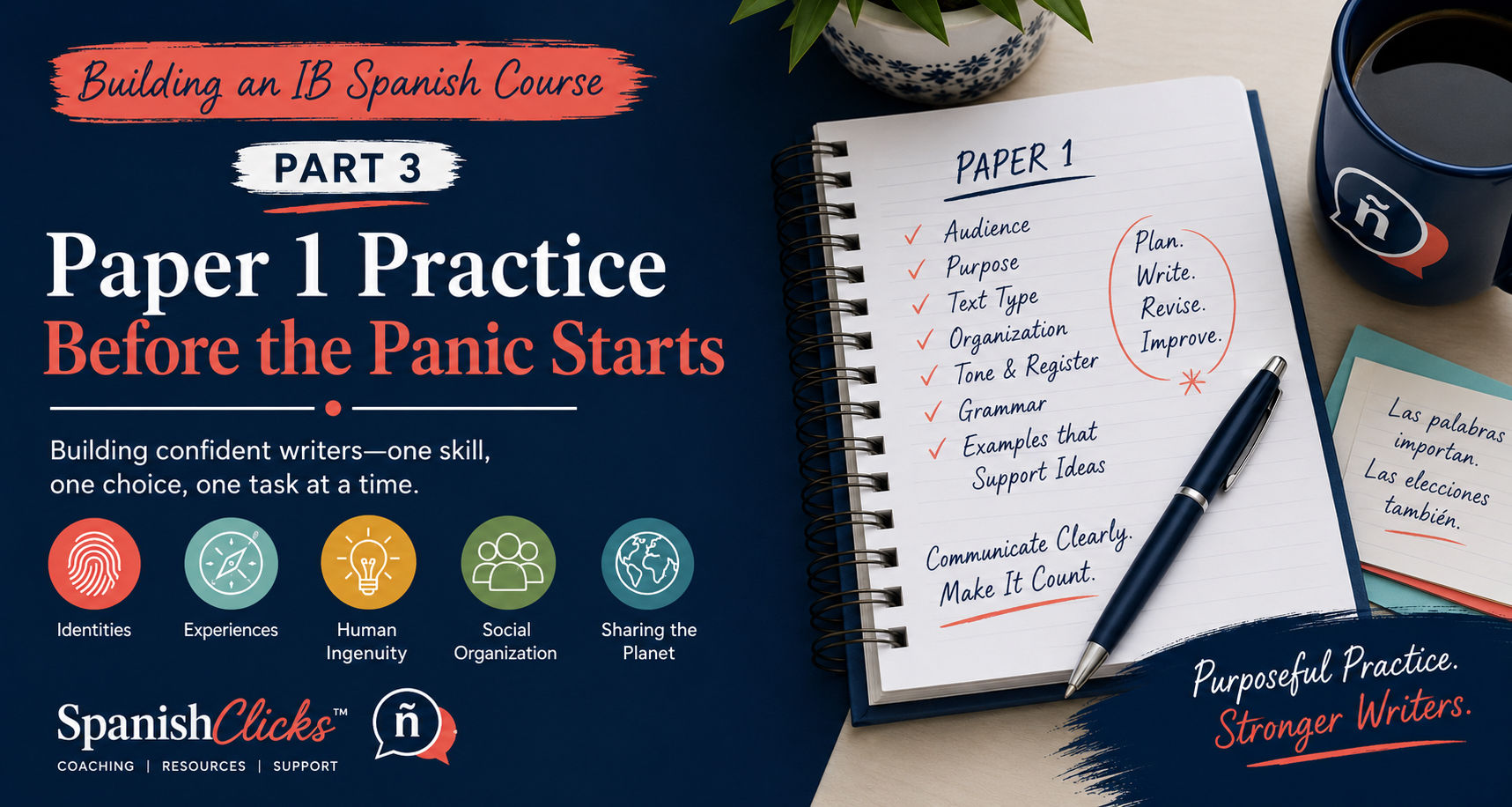
Paper 1 Practice Before the Panic Starts

In the first post in this series, I wrote about building an IB Spanish course by starting with what students need to be able to do. In the second post, I looked at the five IB Spanish themes as lenses rather than boxes. Now I want to talk about Paper 1.
Not because Paper 1 should take over the course. It should not.
But writing is one of those areas where students often need more steady, intentional practice than we realize. They may understand the topic. They may have vocabulary. They may even have good ideas. But when they have to respond to a prompt, choose an appropriate text type, consider audience and purpose, organize their thinking, and do it all in Spanish, the task becomes much more demanding.
That is why I do not think Paper 1 preparation should be saved for the final stretch before exams. By then, students may improve a little. They may learn a few reminders, memorize some openings or closings, and become more familiar with the task. But real writing confidence takes longer than that. It has to be built into the course steadily, without making the whole course feel like test prep.
Over the years, as the IB Spanish course and assessment expectations have evolved, my own approach to writing has become more deliberate. I have always wanted students to write well, of course. But I have become more aware of how many small decisions are hidden inside a strong writing task.
Students have to ask themselves: Who am I writing to? Why am I writing? What kind of text makes sense? What tone should I use? How should I begin? How should I organize my ideas? What grammar will help me say this more clearly? What examples can support my point? How do I end in a way that feels appropriate?
That is a lot to manage in another language.
Sometimes we assume that if students know the topic, they are ready to write. But knowing about technology, health, identity, education, or the environment is not the same as knowing how to shape a written response for a particular audience and purpose.
A student might have plenty to say about social media, for example. But the response will look very different depending on whether the task calls for a blog post, a formal email, a speech, an article, an interview, or a proposal. The content matters, but the container matters too.
That has become one of my strongest beliefs about Paper 1: students need to understand text types as communication choices, not just formats to memorize.
A blog post should not sound exactly like a formal letter. A speech should not sound exactly like an article. An interview should not be written like a personal reflection. A proposal should not feel like a casual message to a friend. Students need to notice those differences long before they are under pressure.
One practical way to build this into the course is to create small moments of text-type awareness throughout the year. Students can look at two introductions and decide which one sounds more appropriate for a formal audience. They can rewrite an informal sentence in a more professional tone. They can identify what makes a blog post sound like a blog post. They can compare how a speech opens versus how an article opens. They can look at a prompt and discuss which text type would best match the audience and purpose.
None of that has to take an entire class period. Sometimes ten minutes is enough. And those ten minutes add up.
I have found that students often benefit from practicing pieces of Paper 1 before they practice the whole task. A full timed writing task has its place, but if that is the only way students practice, they may repeat the same mistakes without understanding how to improve.
Smaller writing routines let us slow down the thinking. One day, the focus might be the opening. Another day, it might be organization, tone, transitions, or choosing details that actually support the purpose of the task. That kind of practice feels less overwhelming for students and more manageable for teachers.
It also makes feedback better. If I collect an entire written response from every student, I can give feedback, but it takes time. If I ask students to write only an introduction, a plan, or one body paragraph, I can focus my feedback more clearly. Students can also focus their revision instead of feeling like the whole piece needs to be fixed at once.
Revision is where a lot of the growth happens.
A student may not fully understand audience and tone until they compare their first version with a stronger revision. They may not see why their paragraph feels weak until they realize they listed ideas without developing them. They may not understand register until they hear how different the same idea sounds in two different contexts.
Writing improves when students learn to notice.
That is why I like using comparison in writing practice. Show students two versions of the same sentence and ask which one sounds stronger. Show them two possible openings and ask which one fits the audience. Show them a weak ending and a stronger ending and ask what changed. Show them a paragraph with vague support and another with a specific example and ask which one is more convincing.
These are small questions, but they teach students how writing works. They also help students develop the judgment they need during a real task.
Paper 1 is not just about producing Spanish. It is about making choices in Spanish.
Another important piece is planning. Many students want to start writing immediately because they are nervous about time. I understand that impulse. But writing without a plan often leads to repetition, weak organization, or a response that drifts away from the task.
Students need to practice planning quickly. Not an elaborate outline that takes half the period, but enough to know where they are going. I like students to think about three simple things before writing: audience, purpose, and structure.
Who is this for? What am I trying to accomplish? How will I organize the response?
That alone can prevent a lot of problems. If the audience is formal, the language should reflect that. If the purpose is to persuade, the examples need to support a position. If the task asks students to address a problem, the response probably needs more than description. It needs explanation and perhaps a solution.
A good Paper 1 response usually does not begin with “What vocabulary do I know?” It begins with “What am I being asked to do?”
Vocabulary still matters, of course. So does grammar. But vocabulary and grammar need direction. They need to serve the task.
This is where grammar can become more purposeful. If students are writing advice, recommendations, or proposals, the subjunctive may be useful. If they are describing experiences or past events, they need control of past tenses. If they are comparing perspectives, they need comparative structures. If they are building an argument, they need connectors. If they are addressing an audience directly, they need appropriate commands, pronouns, and register.
Grammar should not be separated from writing as if it belongs in another unit. Paper 1 gives students a reason to use grammar more intentionally.
That does not mean every written task has to become a grammar lesson. But when students see grammar as a tool for meaning, they are more likely to use it with purpose.
The same is true with culture. A stronger Paper 1 response often has more depth when students can draw from something beyond personal opinion. They might refer to a real issue, a cultural practice, a community example, a statistic they studied, a classroom resource, or a comparison between contexts.
Students do not need to force cultural references into every sentence. That can feel artificial. But they do need a bank of meaningful examples they can use when appropriate. That bank is built all year through articles, images, videos, discussions, and authentic resources.
This connects back to the five themes. The themes give students ideas. Paper 1 asks them to shape those ideas for an audience and purpose.
That is why writing practice should not feel disconnected from the rest of the course. It should grow naturally out of the themes, resources, and conversations students are already having.
After a discussion on technology and education, students might write a short proposal recommending how schools should use artificial intelligence responsibly. After a unit on health and daily life, they might write a blog post for teenagers about building healthier habits. After studying tourism and the environment, they might write a formal email to a local official or an article about responsible travel. After talking about identity and language, they might write a speech for a school event celebrating multilingualism.
These tasks do not have to be full assessments every time. Sometimes they can be short. Sometimes they can be collaborative. Sometimes students can write only the introduction. Sometimes they can plan the response but not write it. Sometimes they can revise a model.
The point is repetition with purpose.
Students should see writing as something they practice regularly, not something that suddenly appears when the exam gets close.
I also think teachers need to protect the course from becoming too exam-heavy. It is easy to overcorrect. We know students need preparation, so we start giving more and more practice prompts. But if every writing task feels like a mini-exam, students can become tired or mechanical.
That is not what we want. We want students to become more confident writers, not just more anxious test-takers.
So I try to think in terms of a writing rhythm. Some writing is exploratory. Some writing is guided. Some writing is modeled. Some writing is revised. Some writing is timed. Some writing is assessed. Students need all of those.
If every piece of writing is graded, students may write safely. They may avoid risks. They may use the same familiar phrases again and again because they do not want to lose points. But if some writing is low-pressure, students can try new structures, test out better transitions, stretch their ideas, make mistakes, and learn from them.
The best writing growth I have seen often comes from small moments when students realize they have options. They realize there is a better verb than tener. They realize they can connect two ideas with aunque or sin embargo. They realize a formal email needs a different tone than a blog post. They realize an example makes their argument stronger. They realize they do not have to translate directly from English.
Those moments are not always dramatic, but they are real progress.
If you are developing or revising an IB Spanish course, I would not wait until spring to think about Paper 1. Start earlier, but start smaller. Teach students to notice audience. Teach them to identify purpose. Teach text types in manageable pieces. Give them models. Let them compare strong and weak examples. Make planning a habit. Connect grammar to what they are trying to express. Use cultural content as support for ideas. Give low-pressure writing practice before high-stakes writing practice.
Above all, help students understand that writing in IB Spanish is not about sounding perfect. It is about communicating clearly, appropriately, and thoughtfully.
That is a skill students can build, one small task at a time.
Up Next
In the next post, I’ll talk about the Individual Oral and how to build speaking confidence long before students are sitting across from you for the assessment.
Because the oral should not feel like a surprise. It should feel like something students have been preparing for, little by little, all year.


Comments