
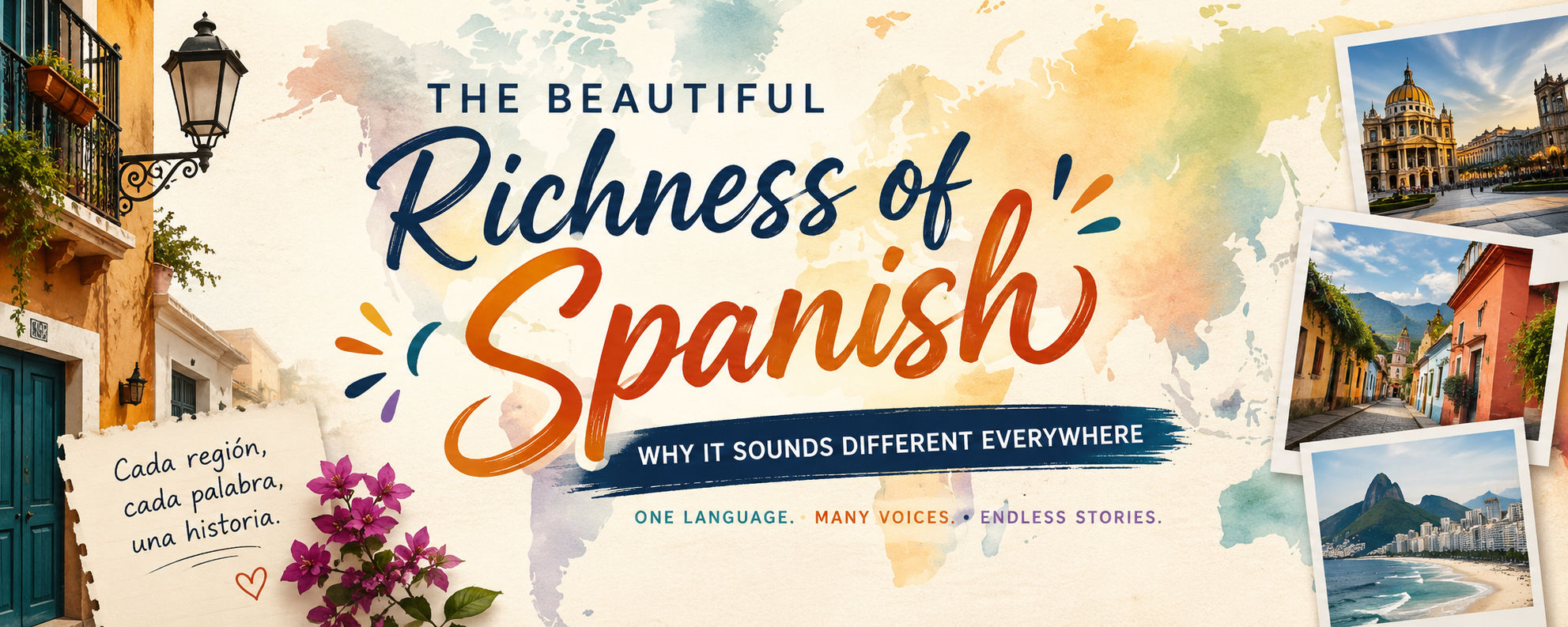
The Beautiful Richness of Spanish: Why It Sounds Different Everywhere
- Jay Rowsey

- Jun 24
- 4 min read
Spanish is often described as one language, but anyone who has spent time listening to speakers from different countries knows the truth: Spanish is beautifully alive, and it changes depending on where you are.
The Spanish spoken in Mexico does not sound exactly like the Spanish spoken in Argentina. Caribbean Spanish has its own rhythm. Spain has regional varieties that can sound very different from one another. And across Latin America, indigenous languages, African influences, migration, history, geography, and culture have all helped shape the way people speak.
That is one of the richest parts of learning Spanish.
Spanish Is Not “One Size Fits All”
Many students begin learning Spanish expecting there to be one “correct” version. They learn textbook phrases, verb charts, and vocabulary lists, and then they hear someone from Puerto Rico, Chile, Spain, Colombia, or the Dominican Republic and think:
“Wait. Why does that sound so different?”
The answer is simple: language belongs to people, not textbooks.
Spanish has traveled across continents, mixed with local languages, adapted to different cultures, and developed its own personality in each region. Pronunciation, slang, vocabulary, rhythm, and even grammar can vary depending on the country, city, or community.
That does not make one version better than another. It makes Spanish more human.
Vocabulary Changes From Region to Region
One of the first things students notice is vocabulary. A simple everyday word can change depending on where you are.
A “bus” might be called autobús, camión, guagua, colectivo, or micro, depending on the region. A “straw” might be popote in Mexico, pajilla in parts of Central America, sorbete in some countries, or something completely different elsewhere.
Even familiar words can surprise learners. Food words, clothing words, expressions of affection, and casual phrases often vary widely.
This is why students should not panic when they hear a word they do not recognize. Sometimes they are not hearing “advanced Spanish.” They are hearing regional Spanish.
Accent and Rhythm Matter Too
Spanish also changes in the way it sounds.
Some speakers pronounce every consonant clearly. Others may soften or drop certain sounds in fast speech. Caribbean Spanish, for example, is often known for its quick rhythm and sound changes. Argentine Spanish has a distinct melody and uses vos instead of tú in many contexts. In Spain, some regions pronounce the “z” and soft “c” differently from most of Latin America.
These differences can feel overwhelming at first, especially for students preparing for AP Spanish, IB Spanish, travel, or real-life conversations. But exposure makes a huge difference.
The more students listen to different voices, the more flexible their ears become.
Indigenous Languages Have Deeply Shaped Spanish
In many parts of Latin America, Spanish exists alongside indigenous languages such as Quechua, Nahuatl, Maya languages, Guaraní, Aymara, Mapudungun, and many others.
These languages have influenced Spanish vocabulary, place names, food words, cultural expressions, and even ways of thinking. Words connected to foods, plants, animals, family, traditions, and local identity often come from indigenous languages.
This matters because Spanish is not just a European language spoken in the Americas. It is a language that has been transformed by the people, histories, and cultures of the places where it is spoken.
When students understand this, they begin to see Spanish as something much deeper than a school subject.
There Is No Single “Best” Spanish
Students sometimes ask, “Which Spanish should I learn?”
The better question is: “What kind of Spanish do I need to understand and use?”
A student with Mexican heritage may want to connect more deeply with Mexican Spanish. A student preparing for IB or AP Spanish needs exposure to a wide range of accents and authentic materials. Someone traveling to Spain, Peru, Colombia, or the Dominican Republic may want to learn the phrases and listening patterns most useful in that region.
There is no single “best” Spanish. There is clear Spanish, formal Spanish, academic Spanish, conversational Spanish, heritage Spanish, regional Spanish, and community Spanish.
All of it has value.
Regional Spanish Is Not “Wrong”
This is especially important for students who grew up hearing Spanish at home or in their communities.
Sometimes heritage speakers are told that the Spanish they know is “incorrect” because it does not match a textbook version. That can be deeply discouraging and unfair.
Regional Spanish, Spanglish, Chicano Spanish, Caribbean Spanish, Andean Spanish, Central American Spanish, and other community varieties are not signs of failure. They are signs of identity, history, and belonging.
Students can absolutely learn formal or academic Spanish while still honoring the Spanish they already know.
Both can exist together.
Why This Matters for AP and IB Spanish Students
For AP and IB Spanish students, understanding regional variation is not just interesting. It is practical.
Students may hear audio from different countries, read articles from diverse Spanish-speaking communities, or discuss global themes connected to language, identity, migration, culture, and belonging.
A strong Spanish student is not someone who memorizes one accent or one list of vocabulary. A strong Spanish student learns to listen flexibly, notice patterns, ask good questions, and understand Spanish in context.
That is what real proficiency looks like.
How Students Can Build Confidence
Students can start by listening to Spanish from different regions without expecting to understand every word. Watch short videos, listen to music, follow creators from different countries, read captions, and notice what changes.
Pay attention to repeated words and expressions. Ask where a speaker is from. Compare how people greet each other, disagree, joke, explain, and tell stories.
Most importantly, do not treat confusion as failure. Confusion is often the first step toward real listening growth.
Spanish Is Rich Because Its Speakers Are Rich in Culture
Spanish changes because people change it.
It carries history, humor, migration, family, resistance, creativity, and identity. It sounds different in different places because the people who speak it have different stories.
That is what makes Spanish so powerful.
Learning Spanish is not about chasing one perfect version. It is about learning to connect with many people, many places, and many ways of seeing the world.
At Spanish That Clicks™, we help students move beyond memorized Spanish and toward meaningful communication. Because when Spanish finally clicks, students do not just understand more words.
They understand more people.


Comments