
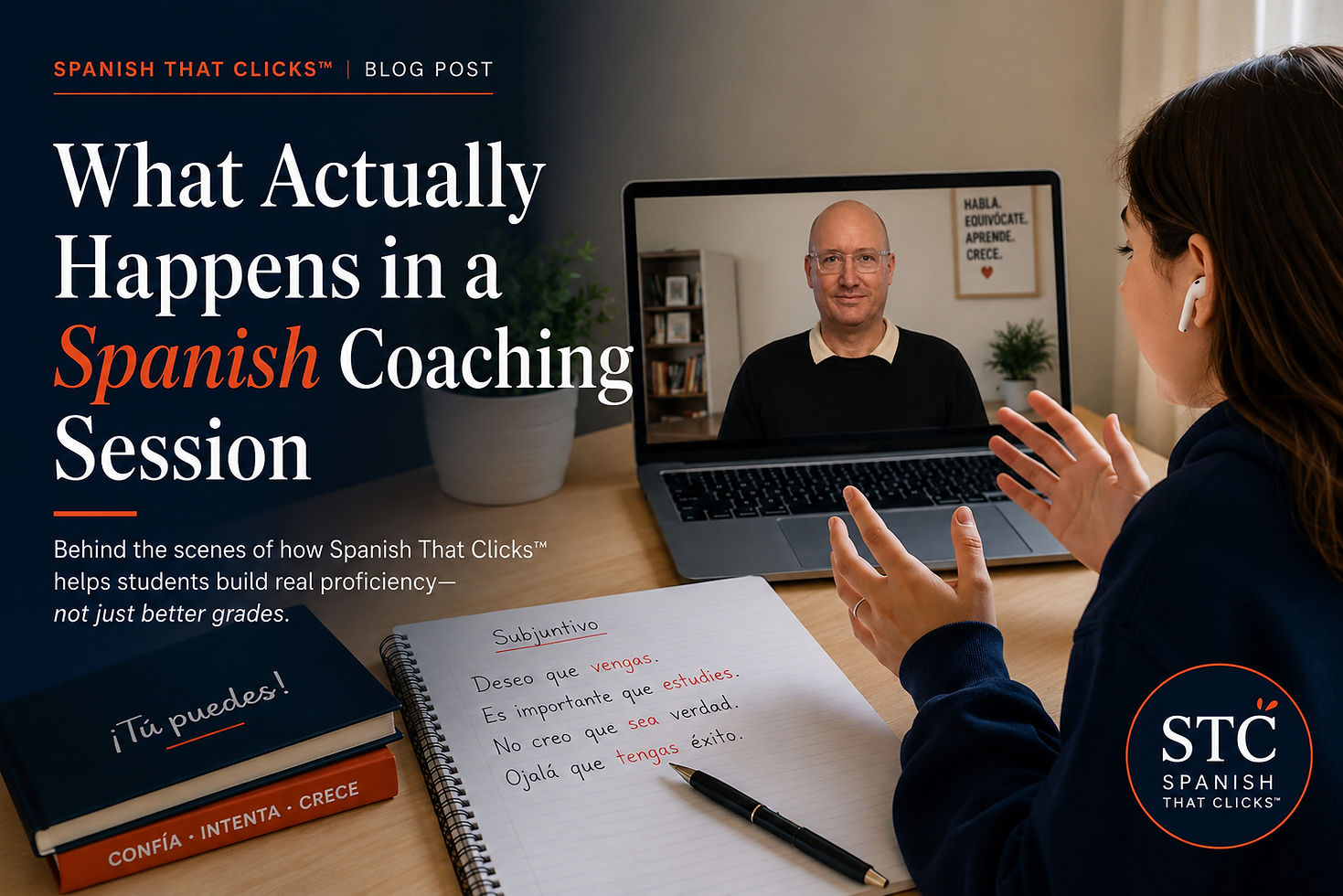
What Actually Happens in a Spanish Coaching Session
- Jay Rowsey

- Jul 25
- 4 min read
Every parent I talk to has the same misconception in the first conversation. They picture coaching as tutoring with a different name. Sitting at a kitchen table, going over homework, drilling verb charts. That's not what this is. It isn't even close.
Here's what actually happens.
Before the Session Ever Starts
I don't accept a student without a Readiness Check first. That's a free 30-minute conversation, usually with the parent and the student together, where I listen to the student produce Spanish and figure out what's actually going on. The report card story doesn't count. I want the real one.
By the time I know we're working together, I have a specific diagnosis. Not "she needs help with grammar." Something like: "She's producing preterite fine but avoiding imperfect entirely, connector words are missing, and her fallback under pressure is to switch to English mid-sentence." That's the baseline. Everything I plan is aimed at moving that specific baseline.
The Session Itself
Every session I run follows the same seven-step arc. It's the same framework I teach with, refined for one-on-one work. Sixty minutes, in that order, every time. Students learn the pattern within two or three sessions and start doing the work faster because they know what's coming.
1. Click-In (5 minutes)
I open with an unscripted question in Spanish. Not "how are you." Something they have to think about. "What's the last thing that made you laugh?" "Tell me what happened in your favorite show this week." No warm-up in English. The point is to switch the language brain on before we do anything else.
2. El objetivo (2 minutes)
I tell them exactly what we're working on today, and why. Not "let's practice the subjunctive." Something like: "Last week you avoided subjunctive triggers three times. Today we're going to make you comfortable enough that you don't avoid them." Named target. Named reason. Students who know the target work harder for it.
3. Haz clic (10 minutes)
This is the instruction moment. Where the concept actually clicks. Not a lecture. A short, targeted explanation using an analogy or a pattern that fits how this student's brain works. For some kids, subjunctive is "the mood of unreality." For others, it's "the mood you use when you're not sure it'll happen." Same concept, different door in. Part of my job is figuring out which door works for which student.
4. Construye (15 minutes)
Build. Guided practice, in Spanish, with me correcting in real time. The correcting is the whole point. This is what an app can't do. When a student says quiero que él viene instead of quiero que él venga, I don't wait for them to finish. I stop them, ask why, guide them to the fix. Then we do it again. And again.
5. Estira (10 minutes)
Stretch. Now they use what we just built on something harder than they're comfortable with. A photo they've never seen and have to describe using the target structure. A prompt with a twist. This is where I see whether the concept moved from recognition to actual production. If it didn't, I know what next session needs to open with.
6. Corrige (10 minutes)
We look at what went wrong. Together. I pull the specific errors from the Estira phase and we work through them out loud. Why did that sentence fall apart? What was your brain trying to do? What tool would have worked instead? This is where students start correcting themselves without me. That's the goal.
7. Conecta (5 minutes)
Close the loop. How does today connect to what we did last week? To what's coming next? To what you're seeing in class right now? Students who see the arc stay engaged. Students who only see one session at a time treat it like homework help, and I lose them by session four.
After the Session
Every parent receives a report the same day. It has five sections, always in the same order:
What we covered. The specific target from step 2, and how we worked it.
What went well. Genuine wins, not padding. If nothing went well, the report says so.
What still needs work. Named. Specific. Not "confidence" or "fluency." Actual structures.
The plan. What next session will address, and why.
The assignment. What the student is doing between now and next time.
The assignment is never a worksheet. It's usually a two-minute voice memo the student sends me before the next session, using the target structure in an unscripted way. I listen to it before they walk in. That's how I know what to open with.
Between Sessions
Parents ask what they should do between sessions. My honest answer: not much, unless you speak Spanish yourself. What matters is that the student does the voice memo. Consistency there beats anything a parent could add. The temptation to over-help is real. Resist it. Your job is to make sure the memo happens. Mine is the rest.
What Changes by Session Eight
I've been doing this long enough to know the arc. Session one, most students are guarded. Answering short. Reverting to English when they hit a wall. By session three or four, they start attempting sentences they wouldn't have tried before, and getting them wrong, which is exactly right at that stage.
By session eight, something different happens. They stop translating in their head first. They pause, reach for a word, get frustrated, and try anyway. They're not fluent yet. But they're speaking Spanish instead of speaking English translated into Spanish. That's the shift I'm looking for. That's what makes the whole thing worth it.
Is This What Your Kid Needs?
Sometimes yes. Sometimes no. The honest answer depends on where they're actually starting, and no report card tells you that.
If you want to find out, book a free Spanish Readiness Check with me over Zoom. Thirty minutes. No pitch.
Sometimes the recommendation is coaching.
Sometimes it's a specific resource I've built.
Sometimes it's just "she's doing fine, keep the memo habit going."
Or if you want a starting point you can work through on your own, the Spanish Readiness Guide is free.
Jay Rowsey is an IB Spanish educator regularly invited to examine for the IB and the founder of Spanish That Clicks, where he coaches learners and supports Spanish teachers with resources built around real proficiency, not just good grades.


Comments